
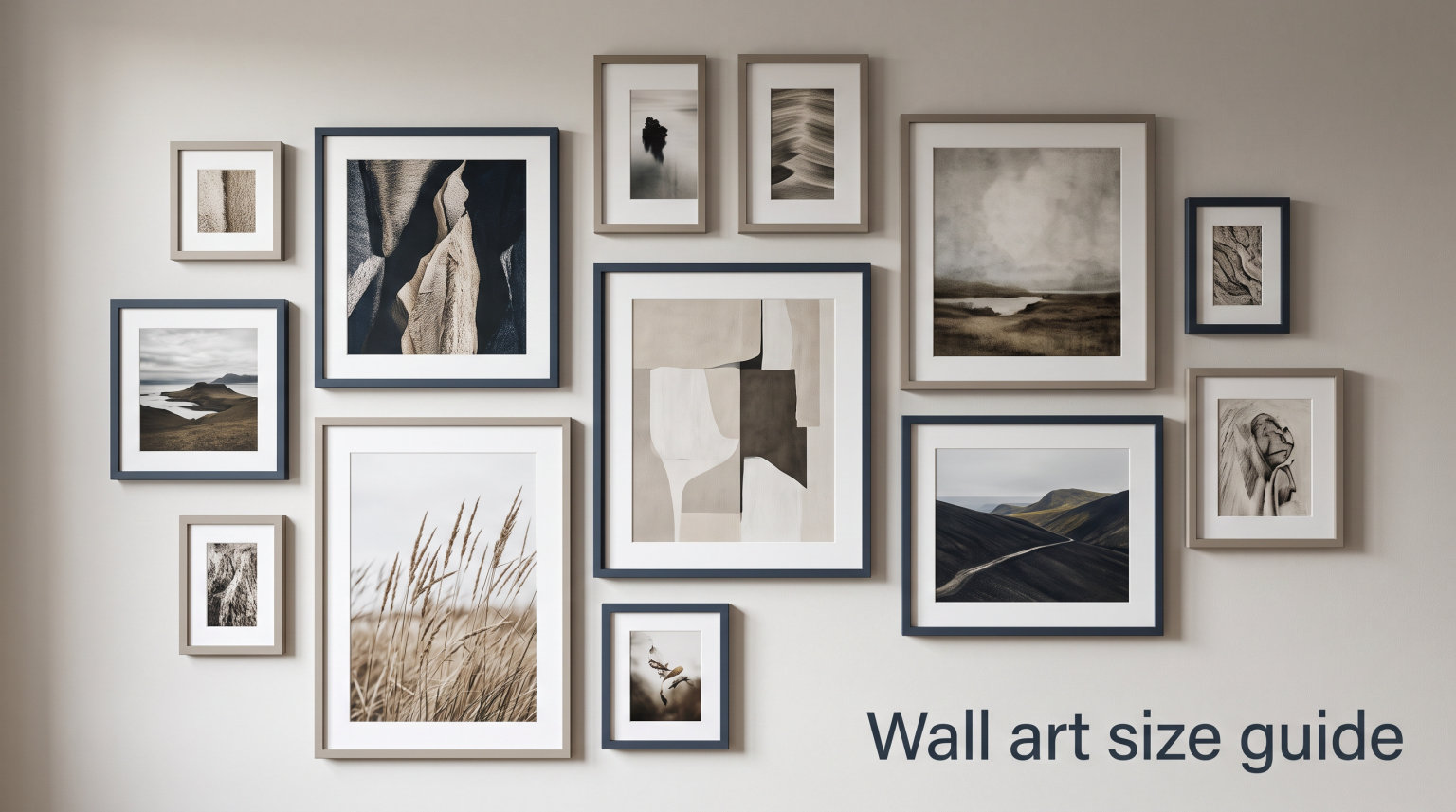
I have framed and shipped hundreds of prints over the last decade, and the same mistake keeps showing up in customer photos: art that is just too small for the wall. This wall art size guide is the system I share with anyone who asks what size to order. It covers empty walls, above-furniture placement, hallways, and the print resolution questions I get every week from clients.
By the end, you will know exactly how to measure your space, calculate the right dimensions, and pick a layout that looks like it was designed by a professional. The rules are simple, the math is easy, and the results change how a room feels the moment you hang the piece.
Table of Contents
- Wall Art Size Guide: The Complete System for Picking the Right Dimensions
- The 60-75% Rule for Empty Walls
- The 2/3 Rule for Hanging Art Above Furniture
- Room-by-Room Wall Art Size Guide
- Standard Print Size Reference
- Print Resolution and Aspect Ratio: A Photographer’s Tip
- Hanging Height: Where the Center Should Land
- Single Piece vs Gallery Wall: How to Decide
- Common Sizing Mistakes to Avoid
- Frequently Asked Questions About Wall Art Sizing
- Bring It All Together
Wall Art Size Guide: The Complete System for Picking the Right Dimensions
The complete system rests on two rules that cover nearly every wall in your home. For an empty wall with no furniture below, art should fill 60% to 75% of the available wall width. For art hanging above a sofa, bed, or console, the combined width of your pieces should equal about two-thirds of the furniture beneath them.
These two rules solve 95% of sizing decisions before you ever pull out a tape measure. Everything else in this guide is about applying them to specific rooms, furniture sizes, and print formats. I will walk you through each scenario with real numbers, then close with the print resolution and hanging height details that turn a good-looking wall into a great one.
The 60-75% Rule for Empty Walls
Art on an empty wall should occupy 60% to 75% of the wall’s total width. Anything smaller looks lost, anything bigger can overwhelm the space. Most people undersize their art, which is why empty walls often feel awkward and unfinished even after a piece is hung.
The 60% mark works for narrow hallways and busy rooms where you want the art to feel integrated. The 75% mark works for statement pieces in quiet rooms where the art is the clear focal point. When in doubt, choose the larger number. I have never had a client regret going bigger on an empty wall.
How to Apply the Rule Step by Step
- Measure the wall width from corner to corner in inches.
- Multiply that number by 0.60 to find the minimum art width.
- Multiply that same number by 0.75 to find the maximum art width.
- Pick any width inside that range based on how bold you want the piece to feel.
For a 120-inch (10-foot) wall, your art should be between 72 inches and 90 inches wide. That is a substantial piece, which is why most people underestimate and end up with something far too small. If a single canvas that wide feels too big, this is where a multi-panel layout earns its place, and I cover that later in the guide.
Worked Calculation Example
Imagine a wall that is 96 inches wide. Multiply by 0.60 and you get 57.6 inches. Multiply by 0.75 and you get 72 inches. So your art should land between roughly 58 and 72 inches wide.
A single 60-inch print hits the lower end and feels balanced. A three-panel set at 24 inches each hits 72 inches combined and feels bold. Both are correct, and your choice depends on whether you want one anchor piece or a coordinated series.
The 2/3 Rule for Hanging Art Above Furniture
When art hangs above a sofa, bed, console table, or fireplace, the combined width of your pieces should be about two-thirds (66%) of the furniture’s width. This ratio keeps the art visually anchored to the furniture without floating in space or stretching past the edges.
The art should also sit 6 to 12 inches above the furniture, never touching it. That breathing room is what separates a styled room from a cluttered one. It also keeps the eye flowing from furniture to art without a hard stop.
Above the Sofa
Measure the sofa frame, not the cushions. A standard 84-inch sofa needs art totaling around 56 inches wide. A common split is one 48-inch piece centered, or two 30-inch pieces spaced 4 to 6 inches apart.
For a smaller 72-inch loveseat, target 48 inches of art. A single 36 by 48 piece works well, as does a pair of 24 by 36 frames hung side by side. Skip the temptation to hang one tiny 16 by 20 print above a wide sofa; it will look like a postage stamp.
Above the Bed
Measure the headboard width and add the width of any nightstands if you want the art to span the full arrangement. For a queen bed with a 62-inch headboard, target around 41 inches of art. A queen typically pairs well with two 20 by 30 prints or a single 30 by 40 canvas.
For a king bed with a 78-inch headboard, target about 52 inches of art. Two 24 by 36 frames or a single 40 by 54 piece both work. The art should sit roughly 6 to 10 inches above the headboard to feel connected without crowding the pillows.
Above Fireplaces and Consoles
Fireplaces and consoles often have mantels or narrow tops that limit how high the art can sit. Measure the mantel or console width and apply the same two-thirds rule. A 60-inch mantel wants around 40 inches of art total.
For narrow consoles in entryways, a single vertical piece often outperforms a horizontal one. A 12 by 36 or 16 by 40 print feels right above a 36-inch console, where a wide horizontal would overpower the scale.
Room-by-Room Wall Art Size Guide
Below is the quick-reference breakdown I use when clients ask me for the short answer. It pulls the rules above into specific dimensions for the most common rooms. Keep in mind that ceiling height and furniture scale always nudge these numbers up or down by a few inches.
Living Room
Living rooms usually have the largest wall space, so art tends to be bigger here than in any other room. Above a sofa, target two-thirds of the sofa width. On empty walls, target 60-75% of the wall width. For a single statement piece above a fireplace, match the mantel width minus about 20%.
A 36 by 48, 40 by 60, or multi-panel set totaling 60 to 80 inches wide covers most living room scenarios. Going larger than you think is almost always the right call in a living room with standard 8 to 9-foot ceilings.
Bedroom
Bedrooms want art that feels calming and proportional to the bed. Above a queen, 36 to 52 inches of art total. Above a king, 48 to 64 inches. Twin beds do well with one 16 by 24 piece each, hung 6 to 8 inches above the headboard.
Keep art on side walls lower and smaller, around 11 by 14 to 16 by 20, so it does not compete with the bed as the focal point. Bedroom walls tend to reward quieter, more personal pieces over loud statements.
Hallway and Entryway
Hallways are where sizing rules get tricky because the walls are narrow but often long. A single horizontal piece at 60-75% of the wall width works on a short hallway wall. For a long hallway, a series of three to five smaller pieces spaced 4 to 6 inches apart reads better than one oversized print.
Entryways reward vertical pieces since ceilings are usually tall but wall widths are limited. A 16 by 36 or 20 by 40 print hung at eye level makes a strong first impression without crowding the door swing or coat hooks.
Dining Room and Office
Dining rooms want art sized to the table beneath them, similar to the sofa rule. A 72-inch table wants about 48 inches of art. A 96-inch table wants about 64 inches. Hang pieces 10 to 14 inches above the table edge so they read at standing eye level.
Home offices are a hybrid. Above the desk, treat it like a console and apply the two-thirds rule to the desk width. On other walls, fall back to the 60-75% empty wall rule. A single piece that ties the room together works better than a busy gallery in a focused workspace.
Standard Print Size Reference
Here are the standard print sizes I print most often at our studio, with the rough room placement that suits each. These are frame-friendly dimensions that work with off-the-shelf frames from any major retailer.
- 8 by 10 inches: small shelf art, gallery walls, bathroom nooks.
- 11 by 14 inches: bedside walls, narrow side walls, desk-side accents.
- 16 by 20 inches: above small consoles, paired bathroom prints, twin beds.
- 18 by 24 inches: above loveseats, dining nooks, single accent walls.
- 24 by 36 inches: above queen beds, narrow sofas, medium empty walls.
- 30 by 40 inches: above king beds, standard sofas, main living room walls.
- 36 by 48 inches: large statement pieces, above full-size sofas.
- 40 by 60 inches: oversized anchors, double-height walls, fireplace surrounds.
Canvas prints add about 1.5 to 2 inches per side for the wrapped edge, so order a slightly smaller file size if you want the finished canvas to match a framed print dimension.
Print Resolution and Aspect Ratio: A Photographer’s Tip
This is the section most other size guides skip, and it is the one that catches buyers off guard. A beautiful image only looks beautiful if the file has enough resolution to support the print size you order. Cropping matters too, because the wrong aspect ratio can slice off important parts of the composition.
Resolution Requirements by Print Size
For a sharp print at typical viewing distance, aim for at least 150 pixels per inch (ppi) at the final print size, with 300 ppi being ideal. A 24 by 36 print needs at least a 3,600 by 5,400 pixel file. A 40 by 60 print needs at least 6,000 by 9,000 pixels.
For wall art viewed from across a room (above a sofa or fireplace), 150 ppi usually looks crisp because the viewer is 6 to 10 feet away. For art viewed up close (above a desk or in a hallway), push to 300 ppi so the detail holds. If your file is short on resolution, downsize the print rather than stretch the image.
Aspect Ratio for Panoramic vs Standard Prints
Aspect ratio is the proportional relationship between width and height. A 3:2 ratio (like 24 by 36) matches most camera sensors and works for traditional landscapes and portraits. A 2:1 or 3:1 ratio gives you a panoramic format that suits wide vistas, ocean horizons, and city skylines.
If you crop a 3:2 image into a 2:1 print, you lose 25% of the frame. If you stretch a 3:2 image to fit a 2:1 frame, it looks distorted. Match the print aspect ratio to your image aspect ratio whenever you can, and crop before ordering rather than after.
Hanging Height: Where the Center Should Land
Once you have the right size, the wrong hanging height ruins everything. The standard rule is to hang the center of the art at 57 to 60 inches from the floor, which is the average eye level for most adults. Galleries and museums use this exact guideline.
Single Piece Eye Level
Measure the height of your frame or canvas, divide by two, and mark that distance above 57 to 60 inches. That mark is where the top of your nail or hook goes. For a 36 by 48 frame, the center sits at 58 inches, so the top of the frame is at 82 inches from the floor.
If you have tall ceilings or the primary viewer in the room is above average height, push the center up toward 60 inches. For low ceilings or rooms where most viewers are seated, drop the center toward 57 inches so the piece reads well from the sofa or bed.
Gallery Wall and Multi-Piece Layouts
For a gallery wall, treat the entire arrangement as one piece. Lay it out on the floor first, measure the total height, find the center, and hang the whole arrangement so its center lands at 57 to 60 inches.
For a multi-panel set hung in a row, the center of the entire row should land at eye level. For a vertical pair stacked above a console, hang the bottom piece 6 to 12 inches above the console and stack the top piece 2 to 4 inches above the bottom piece.
Single Piece vs Gallery Wall: How to Decide
A single statement piece works best when you want a clear focal point, when the wall is narrow, and when the art itself is strong enough to carry the room. A gallery wall works best when you want visual texture, when the wall is wide, or when you have a collection of smaller pieces that belong together.
If you are stuck between one large piece and a group of smaller ones, ask whether the image itself is the draw or the overall arrangement is. A single dramatic landscape reads better solo. A collection of family photos or a series of small studies reads better as a group.
As a rule of thumb, a gallery wall needs at least 18 inches of breathing room on every side to feel intentional. If the wall is too narrow for that, stick with a single piece or a tight diptych.
Common Sizing Mistakes to Avoid
After hanging and shipping hundreds of prints, I have seen every mistake in the book. The most common one is also the easiest to fix: ordering art that is too small. The second most common is hanging the piece too high, with the center well above eye level.
Another mistake is hanging art that is the same width as the furniture beneath it. This looks cramped and pulls the eye downward. Always leave the two-thirds gap so the furniture and art breathe.
Finally, do not skip measuring. Eyeballing works for choosing a paint color, but for wall art it almost always produces a piece that is either too small or too large. Five minutes with a tape measure saves the cost of a reprint and the frustration of a wall that never quite looks right.
Frequently Asked Questions About Wall Art Sizing
What is the rule for wall art size?
Art on an empty wall should fill 60% to 75% of the wall’s total width. Above furniture, the combined width of your pieces should equal about two-thirds of the furniture’s width. These two rules cover nearly every wall in a home.
What is the 2/3 rule for hanging art?
The 2/3 rule says that the combined width of art hung above a piece of furniture should be about two-thirds the width of that furniture. For an 84-inch sofa, that means about 56 inches of art total. The art should sit 6 to 12 inches above the furniture.
How do I pick the right wall art size?
Measure the wall or furniture width, multiply by 0.60 to 0.75 for empty walls, or by 0.66 for above-furniture placement. Choose a print size inside that range, then verify your image file has enough resolution for the dimensions you picked. When stuck between two sizes, go larger.
What size art works for a hallway?
Short hallway walls work well with one piece at 60-75% of the wall width. Long hallways read better as a series of three to five smaller pieces spaced 4 to 6 inches apart. Entryways usually want a single vertical piece at 16 by 36 or 20 by 40 inches.
How high should I hang wall art?
Hang the center of the art at 57 to 60 inches from the floor, which is the standard adult eye level used by galleries. Above furniture, keep the bottom of the art 6 to 12 inches above the furniture surface. For gallery walls, treat the whole arrangement as one piece and center it at 57 to 60 inches.
Bring It All Together
This wall art size guide comes down to two numbers you can apply anywhere: 60 to 75% of wall width for empty walls, and two-thirds of furniture width for art above a sofa, bed, or console. Measure first, pick the larger size when you are stuck, and check that your file has the resolution to support the print you want.
If you are ordering from our studio, send us your wall or furniture measurements and we will recommend the right print size and confirm your file’s resolution before we print. It is the easiest way to take the guesswork out of the wall art size guide and end up with a piece that fits the first time.